Tinnitus Treatment Options: From Sound Therapy to Neuromodulation
It might be hard for people to cope with tinnitus because everyone hears it differently. Some people might only hear a faint ring once in a while; other people might hear a continuous whistling or humming that distracts them from concentrating, relaxing, and sleeping. Knowledge about the Tinnitus Tr
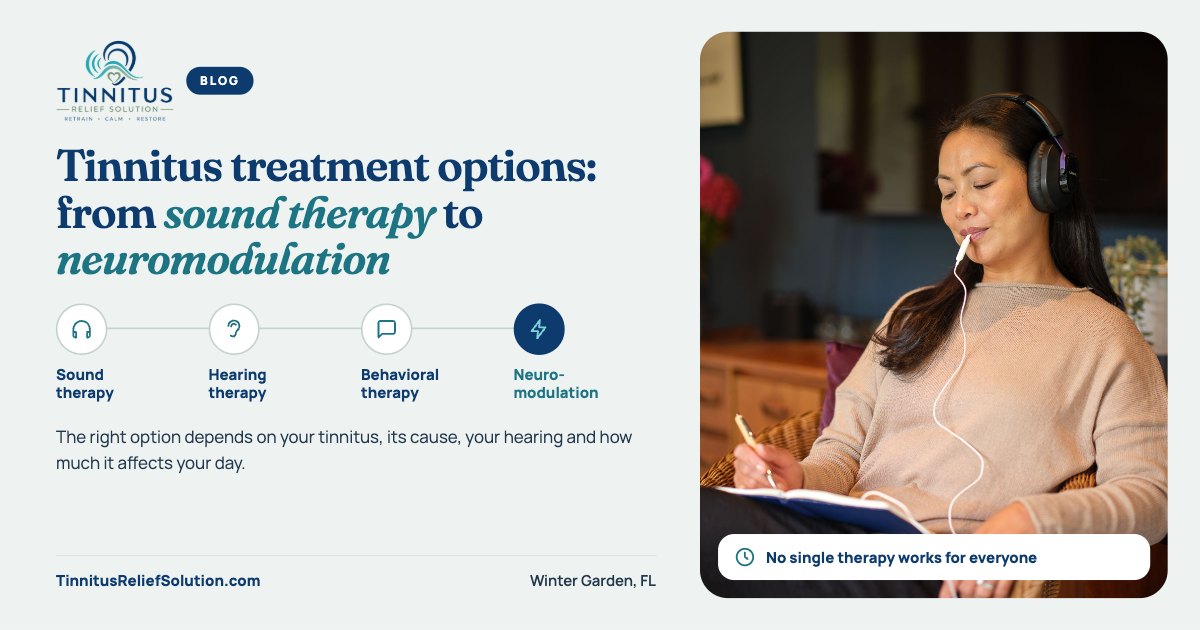
It might be hard for people to cope with tinnitus because everyone hears it differently. Some people might only hear a faint ring once in a while; other people might hear a continuous whistling or humming that distracts them from concentrating, relaxing, and sleeping. Knowledge about the Tinnitus Treatment Options available can be very helpful in finding appropriate management techniques.
Tinnitus Relief Solution focuses on offering information and assistance to those seeking to learn more about tinnitus and ways of dealing with it. No therapy works for everyone. Depending upon factors including the nature and severity of tinnitus, any underlying causes, the state of the hearing system, and the impact the symptoms have on the individual’s daily routine, the therapy can range from sound therapy, hearing therapy, and behavior therapy to even neuromodulation.
Understanding Different Tinnitus Treatment Options
In order to determine the right treatment method, it is first important for one to know the meaning of tinnitus. Tinnitus is defined as the perception of noise or ringing in the ears when there is no actual sound source around. Treatment of tinnitus is often difficult because of several causes of tinnitus; however, the objective of most treatments of tinnitus is to identify the potential cause of tinnitus or lessen its effects.
A healthcare professional may consider:
- Nature and duration of the tinnitus
- Ability to hear and any hearing loss
- If the tinnitus is occurring in one ear or both ears
- Problems with sleeping and concentrating
- Noise exposure
- Medication use or other health issues
This evaluation will assist in determining what management options would be suitable.
Sound Therapy as a Common Management Approach
Sound therapy is among the most discussed methods of dealing with tinnitus. The basic principle underlying sound therapy is that external sounds can help patients reduce the impact of tinnitus on their lives. For each person, it could include:
Background sounds - Soft environmental sounds can reduce the contrast between tinnitus and surrounding silence. White noise - A consistent neutral sound may help some people shift attention away from tinnitus. Nature sounds - Rain, water, wind, or other relaxing sounds may provide useful background noise. Music-based sound - Carefully selected music can be used as part of an individualised sound strategy. Hearing devices - For people with hearing loss, appropriate hearing support may also help make environmental sounds more accessible.
The sound treatment technique may not imply that the tinnitus problem will go away. For certain patients, their objective could be to reduce the impact of the sound.
Behavioural and Psychological Approaches
Tinnitus is not just a problem due to the ringing sound alone; it is also a problem because of the way people respond to the tinnitus itself. In fact, stress, frustration, anxiety, and insomnia can all make the problem of tinnitus worse. That is why the use of behavioral methods can be very useful for treating tinnitus.
Such treatment approaches as cognitive behavioral therapy (CBT) could assist a person to develop a set of strategies to help deal with one’s negative thoughts associated with tinnitus. The idea here is not to tell yourself that the noise coming from tinnitus is gone. Other techniques that could be considered include relaxation techniques, sleep management techniques, and mindfulness techniques.
Hearing Support and Tinnitus Management
Deafness and tinnitus occur simultaneously. With the reduction in hearing ability of the individual, one begins to hear noises in his or her mind, particularly when there is silence around.
A hearing test will help determine whether there is any hearing problem. In case of hearing problems, the hearing aid will help to hear external sounds and also make tinnitus less noticeable. For this reason, a hearing test can prove to be very helpful in researching Tinnitus Treatment Options, especially for those who find it hard to hear normal conversation or other sounds.
Neuromodulation for Tinnitus
Neuromodulation is a rapidly evolving field within the study of tinnitus. As opposed to the existing treatments which concentrate merely on sound stimuli, neuromodulation treatment methods aim at affecting neural activity related to tinnitus. Each neuromodulation technique will rely on the use of either sound, electrical, or magnetic stimulation, among others. This means that each person will have varying approaches to neuromodulation.
Distinguishing between existing clinical procedures and new procedures is essential. Every technique of neuromodulation does not have the same level of scientific basis, and the outcomes may differ. Those who are thinking about this treatment need to talk to a healthcare expert regarding this treatment method and all related issues.
Sound-Based Neuromodulation
These other methods include selecting the right sounds while combining them with other types of stimulation or listening strategies. The objective here is to change the way that the body interprets the tinnitus sounds.
Because these methods can differ considerably in their processes, they are not necessarily interchangeable. It is important to be knowledgeable about a certain therapy before engaging in it.
Comparing Key Tinnitus Treatments
There is no standard pathway for treating tinnitus. Various methods work on various facets of the disease.
Treatment approach:
- Sound therapy - Managing perception and attention - Tinnitus becomes more noticeable in quiet environments
- Hearing support - Improving access to external sounds - Tinnitus occurs alongside hearing difficulties
- Behavioural therapy - Managing emotional and behavioural responses - Tinnitus affects stress, concentration, or daily activities
- Relaxation and sleep strategies - Reducing the impact on rest and wellbeing - Tinnitus interferes with relaxation or sleep
- Neuromodulation - Influencing neural processing - A suitable specialist approach is being considered
- Medical evaluation - Identifying possible underlying factors - Tinnitus is new, persistent, changing, or associated with other symptoms
What is most appropriate depends on the characteristics of the particular person and not necessarily just picking the latest technology.
When Professional Assessment Matters
Tinnitus is not necessarily an indicator that treatment is needed at home without an assessment. There are some cases where there is a need for medical examination, especially if tinnitus is acute, happens in one ear, occurs after an injury, or is accompanied by other symptoms like hearing loss or vertigo.
Healthcare professionals can help in evaluating whether further examination is required, as well as whether an existing illness may have caused the tinnitus. In the case of chronic tinnitus, professional advice is also useful for avoiding the waste of time and effort on treatments which might not be suitable for them individually.
Conclusion
The best tinnitus management strategy will be one that suits the patient based on their particular condition and personal preferences. For one patient, ambient noise can prove to be a useful remedy. For another patient, hearing aid therapy can prove effective. Yet another patient may wish to explore neuromodulation options with an expert.
It is better to explore the various methods that could work in such cases and talk about the possible solutions with an expert. Tinnitus Relief Solution offers information to help one understand tinnitus and try out various ways of dealing with it.
General information, not medical advice. Tinnitus has many causes, so the right next step depends on an assessment of your own hearing.